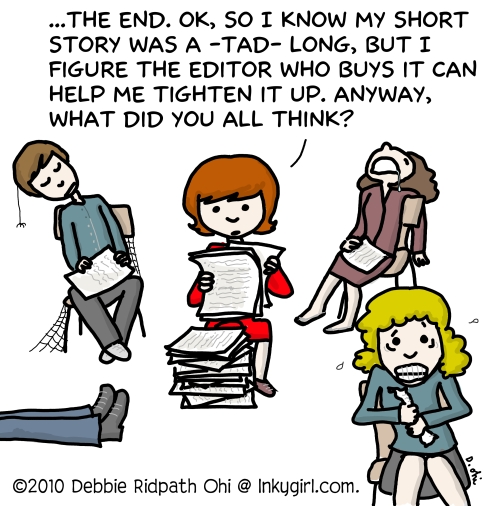
Showing posts with label criticism. Show all posts

Monday, July 19, 2010

I'm a Bad Writer.


Sometimes, I feel like my book is terrible. I read it and I think everyone will HATE it and I will NEVER be successful and I may as well throw myself off a CLIFF because all of my hopes and dreams are being DESTROYED AS I SIT HERE in my gray cubicle in this ADORABLE NEW SKIRT THAT WAS ONLY $5. (Oh actually there was no reason to yell about that one. $5 for a skirt is a really great deal.)

I think everyone struggles with these feelings at one point or another. Everyone gets to that weak spot in their manuscript, or reads a particularly awesome book and thinks, "What I wrote will never, ever be this good. EVER."

What's a writer to do? Here are a few of my favorite options:
  • Whine. You probably have a few writer friends, or perhaps a few supportive IRL friends. So...try a little complaining. It's not very effective at solving your problem, but boy does it feel good! And if you don't have any friends (Aw...) join Twitter! Then the whole Internet can listen to you complain.
  • Read your favorite scene in the whole book. If you want to be productive, make it a line edit. Remind yourself of your best writing, and the things you are capable of doing - those scenes that make you say, "Wow. I wrote that?" Then, you can jump back into your revisions revised and ready to go. 
  • Take a break. Eat some chocolate. Exercise. Just get out of your head for a minute. Sometimes you just need to quiet the mean, critical voice.
  • Revisit past accomplishments. Think about the biggest thing you've achieved so far in your writing career. Maybe it was getting into a difficult writing workshop, or landing an agent. Maybe it was just a really nice blog comment on a blogfest entry or even on a regular entry. Maybe you got an A++ and a gold star on your third-grade spelling test. (Impressive! I once got a 100%, but misspelled my name. #HeatherWIN.) Whatever it is, revisit a past accomplishment. Remind yourself that you are AWESOME and you CAN do it. My accomplishment is reading my VCFA acceptance letter, because I honestly never thought I would see that white envelope come in the mail with my name on it.
  • Edit until the bad writing is GONE. When none of these things work and you still feel like your book is bad, there's only one thing to do...make it better.
I can't lie and say that this banishes all my doubts. I still have them. I still worry if I'm a total failure, if my acceptance into VCFA was an admissions fluke and they're just too embarrassed to admit it, if everyone who's ever read anything I've written is lying through their teeth with any compliment they give. But you have to push those fears aside. Because living in doubt won't get you anywhere.


And now, blog readers, a question...What do you do when you feel so much doubt about your writing abilities that you want to set yourself on fire just a little bit (or maybe just eat an entire gallon of ice cream)?

Wednesday, January 20, 2010

Critiques: Turning Your Plot Upside-Down Since 1485


I want to start out by saying I'm sorry I didn't blog yesterday. I got so many ideas for posts from yesterday alone that I couldn't even decide which topic to address, and I was going to decide at the last minute, but then the last minute came and I laid down in my husband's lap at the early, early hour (for me, anyway) of 11pm and fell soundly asleep in the middle of an extremely exciting episode of Dexter (my new favorite television show). So I've decided to hold off on those genius ideas until next week, or possibly later, because I've been gaining new followers every day and I love that, so now I'll tease you with the promise of more excellent content. 

Now, onto the post: my workshop critique was Monday. I was very nervous. Although I've sent things out to people to read and critique before, it's never happened in real life, where I knew the people beforehand, then had to spend the rest of the week with them afterward.

For the most part, everything went very well in the oral critique. The worst part was that I didn't edit as well as I should have, so I had some tense issues, which caused my teacher, Stewart O'Nan, author of many books to say, "You change tenses so much it makes us want to stab you." Nice.


Once the group got going, they said they generally liked the premise, and no one picked on my writing (out loud, at least, but I'll get to that in a minute). They had some suggestions for plot improvements, one of which I immediately knew I would take, and others that I need to sit on...including one so major that it's literally given me a headache from thinking about it so much. Someone in the group compared the book to Farenheit 451, and I swooned, then realized he was kind of way off base...but it gave me a great idea for a new element to add, and I've been toying with changing that up, as well.

Here's the most frustrating thing that happened, and is a great lesson to you writers out there: I wasn't allowed to talk during the critique, which I thought would be fine. Then they started discussing Kaia's reaction to something that happens, saying they didn't think she would get that emotional because she didn't show emotion over an event that happened in the past. At first I was frustrated. I wanted to scream, "But she DOES show emotion to that other event, stupid!! You just didn't read it right!"

But after they spent three minutes discussing it, I realized something: if nine intelligent people (writers and mostly avid readers) who read the MS twice with the intention of critiquing it hadn't picked up on something, then it wasn't that they hadn't read it right - it was that I hadn't written it well enough. Instantly, I was thankful for the rule that I wasn't allowed to speak, because if I had pointed out the line which mentions it, they would have said, "Oh, OK," and moved on, and I wouldn't have fixed my weak writing.

Tonight, I started looking over the mark-ups and written responses. One of them in particular really stood out to me, because the critiquer literally rewrote a lot of the MS. I'm not talking a suggestion here or there - I mean crossed out half of the page and rewrote it using totally new words and descriptions. Yikes. I always thought that was stepping on the writer's toes a bit. Granted, this particular writer is very good with language. Still, if I think a paragraph or sentence needs work, I'll write something like, "Needs work" or "passive" or "not enough detail." I won't insert detail or rewrite the thing. I do suggest lines occassionally, but I thought this was a lot. Am I wrong to think that? Do most people rewrite a MS they get? (that wasn't my experience with anyone else).

Again, though, I saw a general fondness for my plot, with a few notes on holes (which can easily be patched). Two or three people said I still needed to clean up my writing, and that's fine; I know I'm learning, and that's why I picked this conference. It is great for people who really want to focus on craft. I honestly feel like I can learn to be a better writer, but I can't learn to have a great plot, so I'm very excited about this.

There were a lot of notes on how much they loved my opening, but I'm also thinking I might need to change it based on some other notes I got. I'll still keep the opening line in there, just move it a little later. It's such a great line, and it sets the novel up excellently, but I'm not sure it's perfect anymore. And the opening needs to be perfect.

This whole process was enlightening, though. I'd always heard writers talk about "killing your darlings," but I hadn't yet experienced that. Not that I thought I was so wonderful, but just that I hadn't found anything that I LOVED that I needed to kill. But it's definitely coming now, so I'm starting to get sad. I'll just file it away, though, and remember that it's not dead; it's just sleeping.

Friday, December 11, 2009

Thickening my skin, the journalism way!

In my spare (ha!) time, I write freelance bar and restaurant reviews for a few local papers and Web sites. Recently, I went to a bar that was so awful and awkward, it could only be defined by this:


Ladies and gentlemen, the awkward turtle. 

So when it came time to write the review, I didn't know where to start. As a result, my writing was just as awkward - if not more so - than my experience. I rambled. I told stories that didn't matter. And I trashed the place, going more than 250 words over my word count (and my word count is only 500 words). 

It's no surprise, then, that when I got the edits back, it looked a LOT different than what I had submitted. But rather than get worked into a fury over this, I was relieved. The editors over at the TBT/St. Pete Times took my messy piece of junk and turned it into something readable, nay, enjoyable. They cut down the word count, and turned my lumbering, rambling, incoherent mess into a usable clip which didn't trash the bar so much as tactfully point out its flaws and areas for improvement. I was thankful, and let my editor know as much.


I wasn't always this way. I remember the very first time I ever got published. A story I wrote about my travels in Pompeii was chosen for inclusion in a travel anthology called Italy from a Backpack. I was so excited, and as soon as I got my copy in the mail, I flipped immediately to my page, where I almost cried. They had changed the title of my story - how dare they! I agonized over the title, and thought mine, "The Lost City of Pompeii" tied everything together perfectly, while theirs, "Not as Seen on TV" was so cheesy it was unbelievable. Then I read the thing, and WOW. THEY MADE CHANGES. HOW DARE THEY.  I was crushed, and in every letter to friends and family, or every time I mentioned the book, I would tell people all about the edits and how it changed the story in a terrible, horrible, no-good, very bad way.


Looking back, I know the changes they made were so minor I wouldn't even notice them today. And the title? Please. I could care less about that now, because about 95 percent of the stories I submit to my editors at my day job and freelancing get their titles changed. Just yesterday, in fact, I submitted a story to my editor, and in the email I wrote, "You can change the headline, BTW. That one's just for you." (And it was - the story was about the government long term care insurance plan - the CLASS Act - and I called it, "You stay CLASSy, Congress." I didn't expect her to keep it, I expected her to get a good laugh, then use some modification of the subhead. Which is exactly what she did.) 


After all these years in journalism, I've developed a thick skin when it comes to edits. I know an editor will look at my work with a heavy red pen, tear it to shreds, take out all the ugly words and replace them with shiny new ones. I used to care, but I don't anymore. Because at the end of the day, the article sounds WAY better, and it's still my byline. Sometimes I even read the article, wondering if I really wrote those words, but I never check my original draft (that would be torture). What's more, it's allowed me to become a better writer. I'm starting to write my work articles more in the style of my editor, which I hope makes her job just a little easier. My two freelance jobs might both require me to write reviews, but the two organizations have such different styles that I have to turn a switch in my head when I go from writing one to writing the other. 


I also hope, when I one day make my deal with the universe, meet my agent, and have that all-important meeting with the book editor, I can sit comfortably knowing that, no matter what they tell me to cut or revise, it's still my name on the front of the book.


BONUS FUN: Here's a link to an edited version of a recent review I wrote (it ran in yesterday's Times and today's TBT). It's pretty true to what I turned in, except for the ending. See if you notice the difference between the final paragraph in that link, and this, the paragraph I submitted:


While enjoying my second beer, I chatted with the bartender and some of the other patrons. I even skimmed a few articles in the Union Jack, then paid my tab and went home. 
Grind House is a great little bar. The food menu is huge, and they have some great drink specials. They even have the occasional special parties for Halloween or St. Patrick’s Day. Although they’re not doing anything especially unique, there isn’t an annoying gimmick to get in the way of your drinking, either. If you’re just looking for a regular bar with good prices and a pleasant atmosphere, pay Grind House Bar and Grill a visit.  


Monday, November 23, 2009

The dreaded bad feedback!

OK, I don't really have a lot of experience with this. But it's been on my mind lately, so I wanted to write about it.

I write freelance bar, restaurant, and concert reviews. Part of my philosophy is that almost no one gets a 100% positive review, because no restaurant is perfect. Think about your favorite restaurant. I bet there's something wrong with it, right? Not the food necessarily, but maybe the lighting is too dark, or the bathroom is a bit gross. I just have a hard time saying that everything is kittens and rainbows because I feel like it's not totally honest. You have to seriously blow me away to get a totally, no-negative-words review out of me (Green Springs Bistro in Safety Harbor, FL, is about to come close when it gets posted on the Tampa metromix.com site. That place was to die for.)

Generally when one of my reviews is published, I link to it on Facebook, because I am the youngest child and obviously starved for attention. Of course, this requires me to go back and actually read the review after it's published (always noticing the way the St. Pete Times cuts it up and rewrites it, and MetroMix doesn't touch a word, leaving any careless grammatical errors online for the world to see). This also forces me to view the comments that users have posted between the time that the review went up and the time that I clicked through.

For the most part, my reviews are nice. But every once in a while, I will tear a place apart. I think it's fine, as long as it's earned. The problem comes when people reading the article don't agree with my review. I have to read people calling me out personally, saying I don't know what I'm talking about, and even suggesting that I find a new job. In the review I linked above, I actually asked the friend who went with me to confirm that the food was awful, to make sure that I wasn't living in some delusional world where my taste buds were more sensitive than everyone else's.

Then, of course, there was that review I wrote of the Killers' concert. Now, if your reading comprehension is beyond that of a fourth grader, you will note that I said both positive and negative things. I said that I ultimately had fun, but I just wished they had kicked up the energy sooner. And man did that piss some people off! I can't decide which comment is my favorite: the one that actually links to another, more favorable review, or the one where the guy gets mad at me saying that Brandon Flowers' voice cracked while completely ignoring the fact that I said it was a good thing at that point.

Whenever I see these comments, these little snarky notes on the reviews I've poured my heart and soul into, I always want to write back. Sometimes I get the urge to log in anonymously, creating an alias I can use to defend myself. "This Heather is great! She knows what she's talking about!" Other times, I want to be just as mean to them as they are to me. "Learn to read, jerk-off." or "Did your taste buds break? You think that's GOOD food? Try eating somewhere other than Popeye's and maybe you'll learn."

But I never do. Part of being a writer, especially a critic, is learning to deal with critics of your own. And if I ever am lucky enough to see my book published, I'll have to read a lot more than the lame mutterings of a random Joe on the Internet. Entertainment Weekly gave Suzanne Collins' Catching Fire, the brilliant sequel to The Hunger Games, a C!! (Let's put that in perspective: that's the same grade they gave Sarah Palin's new book, which I haven't read, but I know is crap. Also, if you haven't read those books, you need to. Like, yesterday.)

My point is, reading those comments gives me a thicker skin, and helps me get used to the many criticisms I hope to deal with one day when I'm as famous as J.K. Rowling. If EW wants to give my book a C, I guess that's fine, as long as my ardent fans write in to let them know they got it all wrong.

For now, I'll stick to punching the one-star "rank this restaurant" button to let the world know that someone out there agrees with me. Even if it's just me.
 
Copyright 2009


See Heather Write
. Powered by Blogger
Blogger Templates created by Deluxe Templates
Wordpress by Wpthemesfree