Showing posts with label Writers in Paradise. Show all posts

Tuesday, August 17, 2010

In Which I Shamlessly Promote an Awesome Conference

I sometimes get emails from readers, and this totally makes my day. Often, one of the questions in those emails is, "I'd like to attend a writer's conference, but I don't know how to find out about one. Where can I learn about awesome writers' conferences?"

Well today, you can learn about one right here on my blog.

If you've been following me for awhile, you might remember back in January when I attended the Eckerd College Writer's Conference in St. Petersburg, FL. I had a bunch of posts about what I learned, including:
And all of those lectures (plus the others I attended, including some on agents and publishing) were awesome. But absolutely the most valuable thing I got out of the conference was the afternoon workshop session. 

See, this is how ECWC works. It's a week-long conference focused on craft. In the morning, there are lectures. In the afternoon, you head into breakout sessions divided by genre. (Then in the evening there are readings and signings with wine and cheese. Srsly. AWESOME.) There are about 10 people in each group, and it's basically a critique group where you get and give feedback on your WIP. I learned so much that my head wanted to EXPLODE. I credit ECWC with being the first time that I got feedback that sent my story in a whole new direction. The revisions I did based on my ECWC crits were the first time I looked at my WIP and said, "Uhm, wow. This is almost good."

The experience was invaluable, the people were awesome. They have workshops in poetry, novel, short story, memoir, the middle of your novel (meaning you bring the middle part of your book, not the beginning), and!!!! For the first time EVER they're starting a YA/MG workshop!!! (Last year I just twiddled my thumbs with the Big Kids, but they were still nice to me.)

This will be epic, people. EPIC.

And I have to miss it, because it coincides with the last three days of my very first MFA residency. LAME. (OK, not that lame, because I am WAY pumped about VCFA. But I am a total dork and wish I could do both. My ideal life would be like some sort of writing conference nomad.)

BUT! Here's the good news, dear readers. YOU don't have to miss it! YOU should go. Oh yes, you should. Applications are available NOW! You can come to sunny St. Pete, FL in JANUARY, and it will be warm and you can visit the beach on the day off! (Because the conference is a week long, they give you a day off. They're nice like that. And the college is about, oh, 5 minutes from the beach? One of the optional activities is even a boat ride. A BOAT RIDE. WITH FAMOUS AUTHORS.) The price seems high at first, BUT they offer generous scholarships, and last year they said many of the people there were on scholarship, so don't let the cost stop you. Plus it's a week long so the cost is justified. So just apply. Go. Trust me. If you're looking for a great conference focused on craft (not schmoozing with industry professionals), this is a great one for you.

Plus, if you are awesome and nice, I will probably come and visit you in St. Pete, because it's only like 20 minutes from my house.

OK, that's all. I'll stop now. And I promise that I am in no way affiliated with ECWC and am not getting paid for this post. I'm just a happy alum who wishes she could go back and SO wants someone to blog all about the YA workshop so she can live vicariously through you.

EDITED: To add that the dates of the conference are Jan. 15 - 23, 2011. I was so excited I forgot to include dates. Oops. 

Tuesday, January 26, 2010

Why Adverbs Are Evil

Before we get started...don't forget about my first-ever contest! Win a signed copy of Dennis Lehane's The Given Day or Anita Shreve's The Pilot's Wife!

Now I want to talk about something that we all deal with. Every. Single. Day. Adverbs.

What is an adverb? An adverb is word that modifies another word, and answers questions such as who, how, or why something happened. And they should be avoided at all costs. 

What's so wrong with adverbs? To hammer the point home, I thought I'd borrow this crafty little fellow from Shannon over at Ramblings of a Wannabe Scribe to tell you all about it....


Blog followers, meet Ninjadillo!!!! A high-kicking armadillo who karate-chops adverbs to the curb! Heeyyaahhh!

Ninjadillo was introduced to me by Shannon. Those claws are terrifying, and a constant reminder of the way that adverbs will rip your precious manuscript to shreds if you don't remove them as soon as possible.

Now, I know most of you have heard this line before: get rid of adverbs, it will make your MS better. But do you really understand why adverbs are evil? I'll admit I didn't fully understand it until last week.

The truth is, adverbs make your writing sound weak, lazy, and boring. They dilute the power of the verb they're modifying. Instead of actually taking the time to describe what the characters are thinking, feeling, or doing, adverbs allow writers to insert one word and create a blanket impression of the idea they're trying to get across. When you use adverbs, you're taking away a lot of the meaning that your words could have - if you let them.


Take these two sentences, both of which say essentially the same thing, but only one of which contains any adverbs. 
The drunk entered the room unsteadily and walked noisily into a lamp.

The drunk staggered into the room, knocking over a lamp which crashed to the floor.
In both sentences, we know the man is drunk, having trouble walking, and is making a lot of noise. But the second sentence somehow paints a more vivid picture - the words themselves (stagger and crash) have a slight onomatopoeia effect, and give a precise image of how the man is walking. 

Sometimes, removing the adverb can be as simple as reorganizing the sentence structure, turning:
Suddenly, there was a blinding light overhead.
 into
There was a sudden blinding light overhead.
But getting rid of adverbs isn't always the right thing to do. The thing you want to consider is this: is the adverb telling the reader something they don't already know or couldn't have figured out on their own from context clues? Or can you write a better sentence/paragraph to make those context clues more clear? Another thing to think about is when the adverb is describing something that is out of the ordinary. For example, you wouldm't want to write:
The boy stroked his dog's fur lovingly.
Because, well, how else would you expect a boy to stroke his dog's fur? But the minute the boy pets his dog in a way that shows aggression, well...then it becomes interesting...
The boy rubbed his hands roughly across the dog's back, forcing a whine out of the animal.
 It's possible that this sentence could be improved upon many times over, and eventually that adverb - roughly - could be eliminated altogether for some verb that simply describes rough rubbing (scour, maybe, but that doesn't seem right). But since it is unexpected, it is allowable, and Ninjadillo might retract his claws and allow your adverb to live another day.

The best thing I've heard about adverbs so far was from Dennis Lehane (I think I quoted this last week, but it's worth repeating): "Learn to sprinkle adjectives like salt and adverbs like cyanide." And of course, never forget the most important rule of all - every rule that has ever been written about writing has been broken, beautifully, by some writer, somewher.

Sunday, January 24, 2010

Which comes first: Character or Plot?

Although my conference is over, I learned so much that my lessons will keep on coming! I'm even skipping Sunday Funday to post one today! (Though there is a fun announcement at the end of this, so read through!)

Here's an age-old question in story writing: what's more important, character or plot? Dennis Lehane talked about this last week, and followed that simple question up by saying "Plot without character is an amusement ride. Character without plot is a painting."


And that is so true. Plot and character are linked completely. External events (plot) trigger the internal turmoil that is inherent in your characters, but without the internal turmoil, the plot wouldn't be particularly interesting. In fact, you can build an entire plot based on a great character. But how do you build an interesting character?

One way to start is to think about the room they live in and build out. Consider the contents of their kitchen, their CD player, their book shelves, closet, etc. But although these things round the character out, they don't make the character. What makes the character is their quest for what they want: love, security, fulfillment, value, approval, fairness/justice, etc.

Most of us, when we first start forming our main characters, write someone who is very close to ourselves. You might not want to admit this, but it's true. (Come on, think about your main character, especially who they were in your very first draft. How much did they have in common with you, especially in terms of wants, desires, fears, etc? Probably a lot. Even J.K. Rowling did it, and fully admitted it, with Hermione.) But you lose objectivity in your character, because you can't remove yourself from them. So gradually you write them further and further away from you.

One thing you need to be careful of, something that can make your plot bland and even cliched, is making your heroes too heroic and your villains too evil. (The latter is something I'm struggling with right now.) Because I love HP, and I've already mentioned it, and I think most people reading this blog would get the reference, I'm going to continue with that example. Voldemort is obviously evil and awful. But, there are times in the book when you feel just a little sorry for him, particularly when we see the circumstances of his orphanage. Once we see his upbringing, we understand that he's complex and multi-dimensional. Every time you write about a good character, you need to ask yourself what's bad about them. And when you write about a bad character, you need to ask yourself what's good about them.

I mention all this stuff on character because, as I said before, if you have an incredible character you can create a plot around them. Let's take this list of qualities, totally stolen from an exercise we did with Lehane (the list is from a series of questions we all had to answer, then he drew one at random. These aren't my answers, and sadly I don't have the questions, but you can figure out the questions from the answers):
  1. Passion to learn
  2. Their eyes wander when they talk to people
  3. A bit bossy
  4. Their greatest desire is to be successful
  5. Wants unwanning drive
  6. Her sister has broken her heart, and she hurt her sister as well
  7. She cheated after drinking
  8. Afraid to fail
  9. Phobia of heights
  10. Does volunteer work
  11. Addicted to alcohol, exercise, marijuna, and tea
  12. Makes mistakes when she parties and drinks too much
  13. More than anything, wants to raise enough money to help her parents retire
So when you first look at that list, it might not look like much. But the more you consider it, the more the layers of this complex person start to come apart. As a group, we created a plot involving the MC having to raise the money to help her parents, but her addictions/phobias) kept getting in her way (we had various reasons, like having to go up an elevator for a job interview and not being able to manage it, or showing up drunk/high to an interview, etc.), so ultimately she had to ask her sister for help, and in the end her parents didn't even want the help.

OK, I'll give you another exercise. Here's another list of traits. Write a short story, or just outline a plot, based on the list below. I copied the answers as they were read, so you can interupt them as you want.
  1. Most proud of his wonderous humility
  2. Quirk: lines up Sweet & Low packets
  3. Snorts, not snores, in sleep
  4. Hopes for a quick death
  5. Wants to have their novel published
  6. His girlfriend's death broke his heart
  7. He doesn't like people and they know it
  8. He is afraid of lingering death
  9. Phobia: ferris wheel
  10. Once let down someone in need
  11. Has told big lies to the person he loves the most
  12. Addicted to cheap beer
  13. Once beat up a guy in a bar
  14. Nothing would make his life near-perfect 

In other news, I'm holding my first-ever contest! You all were such great little followers last week, telling me how wonderful and helpful all my posts were, that I've decided to give away not one but TWO signed books by some amazing authors! Tune in tomorrow for the details! (Hint: You might want to start following me now, before it technically starts, to give yourself a leg-up on the competition...)

Thursday, January 21, 2010

Can't Get Your Point Across? Try a Different Form

Today's post is about form. Most of the people who read this blog are primarily novelists, but you might also dabble in other forms. Maybe you don't. If you don't, you should, and here's why:

Using a different form for your writing can put a whole different take on the piece and how it comes across.

My lecture this morning was from Sherri Reynolds, author of several novels and a play, Orabelle's Wheelbarrow. But Orabelle's Wheelbarrow didn't start as a play. It started as a novel, but was rejected by her editor. (Yes, she was already published. Yes, her novel, The Rapture of Canaan, had already been chosen as an Oprah's Book Club selection. Rejection can happen to anyone. Don't give up.) So she sat on it for a little while, but the story stayed with her.

Eventually, she decided to try writing the novel as a play to see if she got any ideas for developing it. She took a playwriting class and ended up with a 200-page play. (For those who don't know, that's....very long. Very.) Then she cut it down more and more, whittling out scenes until she ended up with 120 pages. That play won the Women Playwright's Initative award in 2005 and was published and produced - after she cut another 30 pages.

What does that have to do with anything? The point is, Orabelle's Wheelbarrow didn't work as a novel; it needed to be reimagined and thought about in a new way. So she thought on the form, created an incredible play, and in the end she thinks it works much better that way.

Tonight, I'm going to offer you a challenge....you could even call it an assignment (wow, I feel like Shannon with her USC Lessons over here.) This is the assignment we had in Sherri Reynolds' workshop, so I'll even tell you what I came out with and how I think it will really help me tell a story.

Assignment: Think about a piece of writing you've been struggling with, or a story you've wanted to tell for awhile but haven't been able to. The writing can be anything - a section in your current WIP, a short you've been mulling over, a novel you stuck in the drawer years ago...anything. Then, think about how you might reinvent it and write it in another form. It could be a poem, a piece of flash fiction, letters, a narrative essay, a play, a song, a diary entry, a sitcom - anything, as long as you change the form.

What I did: I know I'm usually full of wit and charm, but this is going to get serious, guys. A little more than six years ago, my mom died. She spent a few days in the hospital in a coma before she finally passed. On my first day visiting her, I held her hand in mine and squeezed it. She didn't squeeze back, and it was the first time I really felt like I knew she was gone (even though she hadn't died yet). I always knew I wanted to write something about the power of that moment, but for years I've struggled to find the words. And today it hit me - that isn't a short story, or even a section of a novel, which is what I'd always tried to write it as. It's a poem, using my mom's hand as a guide for me throughout my life, and showing the times she was there and when she wasn't. It was so obvious when I thought of it today I couldn't believe I hadn't thought of it before. (Probably because I don't really do poetry, but after hearing Beth Ann Fennelly read hers on Tuesday night...wow. I'm a poetry lover.) No, I will not be posting the lame poem I wrote here, unless I can clean it up some. But I do feel, for the first time, that the story is being told the way it should. And I feel so glad that I could finally get it down.

Another great thing that this lecture on form did is show how you can take something like a poem and come up with an incredible plot. We looked at a poem called Eulogy for a Snake Handler Killed by Canebrake. I won't post the poem here, because it's very long, but you can follow the link if you're interested and see that there is a LOT of story in that poem.

So the next time you're struggling to write something, remember - it might not be you, or the story, it might be the form that you're putting the story in.

Wednesday, January 20, 2010

Critiques: Turning Your Plot Upside-Down Since 1485


I want to start out by saying I'm sorry I didn't blog yesterday. I got so many ideas for posts from yesterday alone that I couldn't even decide which topic to address, and I was going to decide at the last minute, but then the last minute came and I laid down in my husband's lap at the early, early hour (for me, anyway) of 11pm and fell soundly asleep in the middle of an extremely exciting episode of Dexter (my new favorite television show). So I've decided to hold off on those genius ideas until next week, or possibly later, because I've been gaining new followers every day and I love that, so now I'll tease you with the promise of more excellent content. 

Now, onto the post: my workshop critique was Monday. I was very nervous. Although I've sent things out to people to read and critique before, it's never happened in real life, where I knew the people beforehand, then had to spend the rest of the week with them afterward.

For the most part, everything went very well in the oral critique. The worst part was that I didn't edit as well as I should have, so I had some tense issues, which caused my teacher, Stewart O'Nan, author of many books to say, "You change tenses so much it makes us want to stab you." Nice.


Once the group got going, they said they generally liked the premise, and no one picked on my writing (out loud, at least, but I'll get to that in a minute). They had some suggestions for plot improvements, one of which I immediately knew I would take, and others that I need to sit on...including one so major that it's literally given me a headache from thinking about it so much. Someone in the group compared the book to Farenheit 451, and I swooned, then realized he was kind of way off base...but it gave me a great idea for a new element to add, and I've been toying with changing that up, as well.

Here's the most frustrating thing that happened, and is a great lesson to you writers out there: I wasn't allowed to talk during the critique, which I thought would be fine. Then they started discussing Kaia's reaction to something that happens, saying they didn't think she would get that emotional because she didn't show emotion over an event that happened in the past. At first I was frustrated. I wanted to scream, "But she DOES show emotion to that other event, stupid!! You just didn't read it right!"

But after they spent three minutes discussing it, I realized something: if nine intelligent people (writers and mostly avid readers) who read the MS twice with the intention of critiquing it hadn't picked up on something, then it wasn't that they hadn't read it right - it was that I hadn't written it well enough. Instantly, I was thankful for the rule that I wasn't allowed to speak, because if I had pointed out the line which mentions it, they would have said, "Oh, OK," and moved on, and I wouldn't have fixed my weak writing.

Tonight, I started looking over the mark-ups and written responses. One of them in particular really stood out to me, because the critiquer literally rewrote a lot of the MS. I'm not talking a suggestion here or there - I mean crossed out half of the page and rewrote it using totally new words and descriptions. Yikes. I always thought that was stepping on the writer's toes a bit. Granted, this particular writer is very good with language. Still, if I think a paragraph or sentence needs work, I'll write something like, "Needs work" or "passive" or "not enough detail." I won't insert detail or rewrite the thing. I do suggest lines occassionally, but I thought this was a lot. Am I wrong to think that? Do most people rewrite a MS they get? (that wasn't my experience with anyone else).

Again, though, I saw a general fondness for my plot, with a few notes on holes (which can easily be patched). Two or three people said I still needed to clean up my writing, and that's fine; I know I'm learning, and that's why I picked this conference. It is great for people who really want to focus on craft. I honestly feel like I can learn to be a better writer, but I can't learn to have a great plot, so I'm very excited about this.

There were a lot of notes on how much they loved my opening, but I'm also thinking I might need to change it based on some other notes I got. I'll still keep the opening line in there, just move it a little later. It's such a great line, and it sets the novel up excellently, but I'm not sure it's perfect anymore. And the opening needs to be perfect.

This whole process was enlightening, though. I'd always heard writers talk about "killing your darlings," but I hadn't yet experienced that. Not that I thought I was so wonderful, but just that I hadn't found anything that I LOVED that I needed to kill. But it's definitely coming now, so I'm starting to get sad. I'll just file it away, though, and remember that it's not dead; it's just sleeping.

Monday, January 18, 2010

I learned, I learn, I will learn: Things got in-tense!


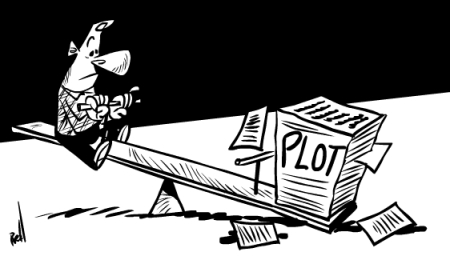
This cartoon has nothing to do with my post, except that I think it's funny given many of my blogging friends' recent posts about their fears that their plot isn't 100% original. Comic from www.inkygirl.com


Before I get started on what I learned today, I have updated stats on how out-of-touch the rest of the literary world is with YA (at least at this conference):
  • My MS was critiqued today (I'll be posting all about the experience on Wednesday, after I've thought about it and looked over my comments), and near the end one of the women - who, admittedly, is probably in her 70s or 80s - had to ask what "young adult" meant.
  • During lunch, I was talking to someone about how Laura Lippman said we all needed to have a novel that was our "role-model novel" - the novel that we want ours to be. I said I've known for awhile what mine is, and the person I was talking to asked me what. I said The Hunger Games and got a blank stare. Then I mentioned The Handmaid's Tale and everything got better. 
  • No comments on my age today, though. Well one, but I sort of said something about it first, and it was a polite mention, not a rude one, or the kind where everyone assumed I was in college.
I am still learning a LOT, though, even if I sometimes feel like not everyone gets me (I do have 1-2 YA writers in my workshop group, though). One of the things we discussed today was the importance of tense.

It all started during my critique, when someone casually mentioned that I seemed to be struggling with my tenses (ugh. I really thought I caught all of them, but apparently not. When I looked back there were so many I was mad at myself.) Stewart O'Nan, who's leading my group, literally said, "You change tenses so much you make us want to stab you." Nice.

But the classmate (who, incidentally, is having a YA novel published in Sweden, where she's from, next year) said something that really got me thinking. Basically she implied that the entire narration, tone, and story of my novel could change depending on the tense.

And she's absolutely right.

I have to admit...and boy is this going to make me sound like an amateur...but when I started writing this book, I picked first-person POV with a past-tense voice because that's what I like to read. I like to get inside character's heads, and I think past-tense sounds more natural somehow. I don't know, it just felt right to me, so I didn't think about it too much. I briefly played with present tense (with the result that every single person who looked at my frist draft commented on my inability to keep to one tense) but ultimately decided past sounded better. That was that.

But my classmate got me thinking: when you choose your tense, what you're really doing is deciding when your narrator is telling the story from. If you use present tense, then the narrator is telling the story as it happens - no problems. But if you choose past tense...well, that opens up a whole can of worms.

Past tense can mean the narrator is telling the story from so many different times - anywhere in the future, really. It can be five minutes from now. It can be at the end of the events of the book. It can be at the end of the events of the book series. Or it can be at the end of the narrator's life.

Now, think about this: if your narrator is telling the story from a time far, far in the future (or even after the book happens) that means they already know everything that takes place in the book. And although that doesn't mean they need to react any differently, that does mean certain things might stand out that wouldn't have if a story was narrated as it happened.

Let's consider this example: a girl and a boy go to the store, and on the way to the store they got mugged. The girl dies. If the boy narrates the story from the present tense, he might emphasize what seems important about the trip to the store, because he's living in the moment. So he might talk more about the fact that they're out of eggs and he's annoyed with the girl for not telling him before they wanted to bake a cake, etc. But, if he narrates using past tense, he already knows that she's going to die. Instead of being annoyed with her, he might point out some good things, too, (of course he still wants to show his annoyance, since that was part of the initial experience) or he might point out how the girl had her money hanging out of her back pocket, making her an easy target.

Maybe that's not a great example, but you get what I'm saying: the tense that you choose has a lot more to do with what sounds good. You also need to think about when the narrator is telling the story from. No matter what tense you choose, make sure you can answer these questions:
  • When does the story take place relative to when the narrator is explaining things?
  • If the narration is far in the future, do you want to play with omniscience? Just because the narrator knows all doesn't mean he or she has to tell the reader. 
  • If you write in the future tense, you are probably writing something crazy, and I might want to read it. Unless it's crazy. 
So that's the explosion my mind has been going through today (along with a few more).  Am I the only person on the planet that didn't understand how important choosing your tense was? I'm not changing it; I like working with the past tense. But I do need to decide how far ahead she's telling from, and what she already knows, just to give context to what she's telling readers.

There were a few other things I learned, just little tidbits which don't fit in with this overall "tense" theme. They include:
  • Don't describe your character's clothes just because; everything needs to have context.
    • Example: Don't say "The 40-year-old was wearing jeans and a shirt from Hot Topic." have one character say to the 40-year old, "Aren't you a little old for that shirt? What are you, going to a rave?"
  • Don't write for people with ADD, but always keep the story moving forward. It doesn't have to move forward like a bullet, it can move slowly, as long as it moves. 
  • A scene ends when a character gets or does not get what they want or need. The novel ends when the character gets or does not get their super objective. (Dennis Lehane loves the ending of the movie Sex, Lies, and Videotape because it ends exactly where it should.)
  • Finally, the quote of the day, "The best thing that can ever happen to writers are the accidents. Don't ever walk away from a character that speaks to you." - Dennis Lehane

Sunday, January 17, 2010

On beginnings

Edit: I realized after I wrote this that this post is not at all witty, like I normally strive to be. Sorry. I literally got three hours of sleep last night. I'll try harder tomorrow. (Which shouldn't be hard, since I'm getting workshopped tomorrow!) But there is a LOT of great info here, so don't let the lack of my normal charming sense of humor deter you. ;)

Today's morning workshop was all about beginnings.

Gone are the days of the 19th century manuscript, where authors could spend page after page after endless page setting up scenes, themes, and motifs. The sad truth is, no matter how amazing the rest of your book is, the first 250 words better be the best writing in the entire thing, otherwise agents, editors, and eventually the general reading public will never get past the first page. Anita Shreve admitted that there is way too much emphasis on the beginning, but it's true; if your novel doesn't grab the reader right away, it will be auto-rejected, tossed to the side, or put back in the stacks. Worst of all, busy agents and editors are searching for reasons to turn your novel down; knowing they can put your book aside means they can easily move on to the next manuscript.

So what makes up a good beginning? The most important thing is arresting, beautiful writing. Anita Shreve admitted that wasn't particularly helpful, because it's mostly a gut-feeling kind of thing. She looks for the kind of beginning that leaves her with a shiver in a chest. She did read two examples of her favorite beginnings, one of which I've included below:
Mum says, "Don't come creeping into our room at night."
They sleep with loaded guns beside them on the bedside rugs. She says, "Don't startle us when we're sleeping."
"Why not?"
"We might shoot you."
"Oh."
"By mistake."
"Okay." As it is, there seems a good enough chance of getting shot on purpose. "Okay, I won't."
So if I wake in the night and need Mum and Dad, I call Vanessa, because she isn't armed. "Van! Van, hey!" I hiss across the room until she wakes up. And then Van has to light a candle and escort me to the loo, where I pee sleepily into the flickering yellow light and Van keeps the candle high, looking for snakes and scorpions and baboon spiders.
From Don't Let's Go to the Dogs Tonight by Alexandra Fuller. There is a mistake, though, because you can't hiss the words "Van, Van, hey!" since there aren't any S's, but it took Anita Shreve five reads to notice.
 
There are several different ways to start a novel, including dialogue (which, incidentally, Dennis Lehane hates, because he likes to immediately know what's going on, but Anita Shreve is OK with it as long as she finds out soon enough what's happening), the telling of a tale, setting description, what the character is doing (AS's favorite), or a description of the relationship between the characters.

More importantly, though, are the ways not to start a novel. They include:
  • Descriptions of the sky or weather, because it happens so often it's now an auto-rejection (Hilariously, when she was saying this, she actually said "awful" instead of "often" the first time)
  • Waking up/dreaming, because it's a cliche, and with dreams there's a sense that you're cheating the reader because they're investing their time in something that isn't real
  • Letters (AS's editor said he always skips over dreams and letters in books)
  • A woman driving in the car with the wind blowing in her hair
  • They were 50-50 split on whether or not prologues were OK
Then we played a game called "Writer Idol." Dennis Lehane, Anita Shreve, and Tom Franklin sat at the front of the room American-Idol style. An actress read the first 250 words of anonymously submitted openings, and if any of them heard something that would make them stop reading, they would raise their hands. If two hands went up, the reading stopped. These are the things that made them raise their hands:
  • A bullet in the shoulder on the first line (arresting doesn't mean startling, it means well-written); it was too jarring and the author was coming in too hard. (Lehane said he doesn't like the beginning of Lethal Weapon 2 because it opens in the middle of a car chase with no context)
  • "My own personal opinion," because it's a sign of weak writing since it's redundant times three (obviously your opinion is your own and it's personal)
  • overwriting
  • confusion; when they didn't understand what was going on
  • sky/weather (one piece mentioned it three times in 250 words)
  • waking up
  • "shards of pain broke through his thoughts" (this phrase, on its own, was enough to get a work rejected since it has cliches and signs of weak writing)
  • lack of character or action
  • unspecific - the character had a thought but wouldn't tell us what it was. He was being needlessly coy.
  • Adverb overkill (the example was touching a pet - the author wrote "lovingly brushing his fur." Lehane said if someone brushes the fur non-lovingly, then he'll take the modifier, because it's not expected) Use adverbs the way you use salt.
  • Cliches
  • Unrelated, today's tally on number of comments on my age: 2.5. (One was in reference to the amount of YA I read, which I said I do because I love it, but also because I want to keep up my genre, and she said, "Plus you're in that age group anyway." *headdesk*)
Finally, two quotes I love (though there were several - follow me on Twitter for tweets throughout the day!)

"Read your first ten pages and find your most arresting sentence. Make that your first line." - Anita Shreve

"Any rule I give you, some writer, somewhere, has broken it beautifully." - Tom Franklin

Saturday, January 16, 2010

As Anita Shreve Once Said to Me...

Today was the first day of my conference!! Sort of.

It was the first official day, but really all that was on the calendar was registering, a campus tour, and Anita Shreve's reading/signing (plus a welcome reception). But since I was way too excited for my own good, I went down to St. Pete and checked in at 3:15 - a solid 45 minutes before the campus tour began. Unfortunately, there were some clouds in the sky, and a little bit of ominous thunder, so the conference coordinator said the tour may or may not be canceled.

I decided to kill the time between the present (3:18) and the tour by wandering down to Haslam's bookstore, which I had Googled in anticipation of needing a way to entertain myself.

And...wow. This was seriously the coolest bookstore I have ever been in! They had a mix of used books and new books, and it was GIGANTIC. It was arranged a little haphazardly, but since my life is arranged that way as well I totally appreciated it. I walked out with two used books and one new for less than $20. Needless to say, I will be back.

Unfortunately, I missed the campus tour, which I found out later wasn't canceled. So I wandered aimlessly in my car for 30 minutes, almost got in an accident, then ate dinner at an Italian place where I was easily the youngest person by 60 years.

Finally, I made it back to campus, where Anita Shreve's reading was about to begin. Dennis Lehane introduced her and, as it turns out, he's absolutely effing hilarious! I can't wait for his reading on Saturday because I LOLed so much tonight! He's also seriously down to earth. After her reading (and the signing, where I risked a side-eye from Ms. Shreve to say "Please don't put my name on this book, I'm giving it away on my blog" (soon, soon! Calm yourself!)), we had a welcome reception, where I got to know a few of my fellow writers, as well as Laura Lippman, one of the faculty members, and the kind of writer who makes you a fan just by having an awesome personality.

Here are some highlights from the evening:
  • Watching Anita Shreve (AS from here out) do her reading and seeing the rapt faces in the audience I knew - I want that.
  • AS made me feel like I should write about things that matter. (She talked a lot about her time in Africa, since her new book takes place in Kenya.)
  • AS lived in Kenya for three years in the late 70s, and always wanted to write a book that took place there. But she was afraid of it turning into a book about herself, so she had to wait long enough before she could remove herself enough that she wouldn't be writing about herself.
  • Both Dennis Lehane (DL) and AS hate the question "Where do you get your ideas?" and they think all writers hate it. DL said, "We give these long, complicated answers, but the truth is, 'my ass.'"
  • AS: "After 15 novels, you'd think I would have learned something, but I haven't. With each novel, it's like I've never written one before. The pleasure of writing is in changing the form, changing the voice, and that's why you never learn anything." 
  • AS has a broad-strokes outline, with the three (or so) main events, and she knows how it's going to end, but that's all she goes in with. It also changes as she writes. 
  • AS rewrites so much that she printed it all out for her son's class and the stack was well above her head (and she's taller than me, I think, and I'm 5'5")
  • DL: "You think people confuse giving birth with raising the child? 'Well, I wrote the draft!' Yeah, but you didn't raise the thing!"
  • AS: "I can always tell the point in the book when the writer got bored." (There was an audible sigh/groan in the room when she said this.)
    • To follow up, DL asked, "Have you ever fallen asleep writing?" AS: "No!!!!" DL: "I have. And that's how I knew I shouldn't write that scene."
  • AS and DL both talked about how authors always want to write the opposite genre, but editors either tell them no (AS) or say a sarcastic OK, knowing they'll lose interest or it won't work out (DL)
  • Fun fact: AS is married to a man she met when she was 13 at summer camp. Years later, he saw her picture in a NYT ad and wrote her a letter. They had an old-fashioned correspondence, then they met and got married. (This has influenced her work.)
  • When AS is writing a book, no one knows what she's writing about - not even her editor or her husband. She thinks it's like letting the fizz out of the champagne bottle. 
  • AS thinks this time is the toughest it's ever been for new authors trying to break in. But for short story writers, e-books might be a place for them to find publication. (She sees eventual potential for new authors there, too.) She thinks e-publishing will change everything and will make writing more accesible to everyone.
  • Laura Lippman: "You can't take good reviews seriously because then you have to take bad reviews seriously, as well."
  • Now, a funny story: A participant (who's not in my workshop, so she didn't read my MS) asked what my novel was about. I told her. Before I could finish, she interrupted twice and said, "Oh, that's just like ________ !!!" (Exactly what every writer wants to hear.) She did have a little smirk. Once I finished explaining, though, she said she liked the idea. Then I asked what hers was about. She wouldn't tell me, and said she thought like AS, that every time she talked about her story it was like letting the fizz out. Uh...1. You asked what mine was about, how did you not think I was going to ask back? 2. This is the piece you're workshopping. You could at least tell me about the first 25 pages (which is what I focused my description on....plus we all turned in summaries anyway.)
  • I only met one person who's in my workshop. He looked at my name tag, then said, "Oh, you're the reporter." Me: "How did you know??" Him: "...." Me: (figures he Googled the whole class) Him: "I looked up some local restaurant reviews and saw your name in a byline." Me: (Decides to play nice.) "Cool." Him: "Sorry, I marked your pages up a lot." Me: "It's OK! I'm here to learn, so the more you mark, the better." Him: "But I did say at the end that I thought it was like a Stephen King fossil - it needs work, but it could be a great story." (And I think that's AWESOME. I can make/am making it better, so I feel great about that.)
  • Number of jokes/questions about my age: 3.
  • Number of times I was told being a journalist first is awesome: 5.
And finally, I leave you with this exchange between DL and AS:

DL: "There are a lot of aspiring writers here tonight, and I'm sure they'd all like to say at a party some day on their blog tonight, 'As Anita Shreve once said to me...' So, what advice do you have?"

AS: "Don't give up. The road is long and the obstacles are huge, but if you really think you've got it don't give up. There were many times I could have given up ... I wrote my first novel at 43 ... Don't get discouraged because it's tough in the beginning."

Friday, January 15, 2010

Now would be a good time to follow me.

I know your type. You stop by here every once in awhile. Maybe you follow the link from my Facebook or Twitter profile, or you click on my name when I comment on someone else's blog, only to find yourself facing that impossibly cool (if slightly out of focus...the jpg conversion didn't go well) Wordle header. You're a regular visitor, but not yet a follower, and I have to tell you...now would be a good time to scoot your mouse over the the right and click that little rectangle, my friend. 

Starting tomorrow, I'm headed down to St. Pete (a whopping 30 minute drive) for a whole week of workshops, lectures on craft, talks on how to get an agent or get published in a literary magazine, and more. And I'm going to share everything with you, which means I'll be laying all kinds of knowledge on your minds. (I'm more than happy/excited to do this. We get a two-hour break every day between dinner and the evening reading series, and there's no way I'm going to come all the way home and go back again, so I'll spend the time posting a blog update then reading, when I'm not spending time with my super cool new writer friends.)

Better still, at the end of the week (more like the beginning of next week, I guess, since the conference goes from Saturday to Saturday) I'll be giving away some signed books!! And in order to win, you're going to need to be a follower. So you might as well just get it over with now and clicky click on that little button over there. I know it's calling your name.

Still not convinced? Here's a schedule of events/preview of posts for next week (there are workshops every afternoon, so I didn't list those, and various social events thrown in, only one of which I listed because, well, it's a BOAT CRUISE):


Saturday: Registration, campus tour, Anita Shreve reading

Sunday: Anita Shreve's Lecture on Craft (Beginnings), Stewart O'Nan & Sterling Watson reading

Monday: Roundtable discussions (I don't know the topics yet, sorry!) and the day my MS gets critiqued in workshop session. CUE HEATHER'S FREAK-OUT. Ann Hood and Beth Ann Fennelly reading.

Tuesday: Dennis Lehane's Lecture on Craft, evening boatcruise, Tom Franklin & Peter Meinke reading

Wednesday: conference free day! (I might post Tuesday's entry today, since that day is pretty full, or I might use Wednesday's post to divulge everything everyone wrote on my MS pages)

Thursday: Dennis Duhamel's Lecture on Craft, Sherri Reynolds' Lecture on Craft, Dennis Duhamel & Sherri Reynolds' reading

Friday: Panel on editing and publishing, Michael Koryta and Laura Lippman readings


Saturday: Literary Magazines and University Presses, Finding an Agent, Dennis Lehane's evening reading

So if any of those topics sound interesting to you, or you'd want to hear what any of those authors have to say, then follow me now, and pay attention all week, because I will be taking notes and posting them here.

Until tomorrow...woot!

Tuesday, January 5, 2010

Just a quickie! (And a contest!...but not mine)

Edit: After titling this, I realized that apparently I don't really know the meaning of a "quickie." Hm...

First thing's first: Sara at The Babbling Flow of a Fledgling Scribbler is having a pretty cool contest. You should sign up! You should also follow her blog, because it is awesome. (And if you do follow her blog, and it's because I said it was awesome, then please let her know that I sent you, because I really want to win The Dark Divine. Like, really. And I could always use some more books on craft (especially since I'm currently editing my first draft...eek!)

Speaking of that whole editing thing....it is very time-consuming, this book editing. I have hardly any chance to read the pile of library books I have, not to mention the nine 25-page manuscripts I have to read by January 18 for my conference. But I'm plugging away, and things are going...OK I guess. This is the first time I've done this, so I have no benchmark to say if this is easier or harder than the first novel I edited. Plus the MC for my next novel just won't get out of my head. (LEAVE ME ALONE, JULIE ALONSO/HERNANDEZ/OROPESA. I HAVEN'T EVEN SETTLED ON A LAST NAME FOR YOU YET, CLEARLY IT'S NOT YOUR TURN, AND IF THINGS GO WELL FOR KAIA YOU MIGHT HAVE TO WAIT SEVERAL YEARS, SO STFU.) But it's fun. The aforementioned Sara inspired me to start keeping all of my deleted scenes in a separate "deleted scenes" file, so now I'm doing that. It's going to be depressing at the end to see how much ends up on the cutting room floor, but ultimately I might get a kick out of it.

Since I can't actually read a novel that isn't for my workshop/crit, I've been listening to Shiver on audio on my way to and from work (literally a 10 minute commute. I also ate lunch in my car yesterday, but I parked by the water so I didn't feel too lame.) I'm still on the fence about it. The writing is beautiful, if occasionally overflowery, and I love the alternating narrative (and my narrators are AMAZING). The author definitely handles that well. But Grace and Sam haven't pulled me in as characters yet, and their story isn't exciting yet. I'm only about halfway through, though, so we'll see. 
 
In other news, my amazingly talented graphic artist friend (who is probably reading this right now and blushing/laughing that I'm even mentioning this) has agreed to take time out of her busy winter vacation from school to design me a new blog layout! Hooray! I'm very excited for this, and you should be too. Having talented friends is amazing, and when she gets married maybe I'll awkwardly read a weird poem about love or something.*

And finally, I realize that I live in Florida and have no right to complain, but our heat doesn't work and it's 50* inside my house. Considering that we normally keep it around 78*...Typing hurts my fingers. If anyone buys me these, I will be your BFF. Kthanksbye.

#BacktoeditingIgo**

*I'll take random Sex and the City reference for $500, Alex.

**Because, of course, #hashtagsareawesome

Sunday, December 27, 2009

In which Heather plays catch-up

I didn't mean to take a break from blogging this week. It just sort of happened. I usually write my posts late at night, or on my lunch break at my day job, so since I wasn't really turning on my computer, and I haven't gone to work in 4.5 days, I haven't blogged in awhile. Oops.

I do have a lot to share, though! I'm going to write everything out in a list, because I love lists.

1. It's Sunday, so I feel like I should start with Sunday Funday. A lot of people were on hiatus this week, but there are two epically awesome posts that I need to point out: Shannon's story that she wrote when she was 11 (Earth Had a Snack) and Frankie's untitled story she wrote when she was 10. Both of them are awesomely hilarious, and even better they started a blog war! You should also read this fun post at Book Dreaming, which highlights some quality student writing samples (and enter her contest while you're there!)

2. OK, the big news: I FINISHED MY FIRST DRAFT!!! Woot! This actually happened a few days ago (almost a week, in fact), and I tweeted about it (reason number 900 why you should follow me), but, as I said before, I haven't had a chance to post here in awhile. So I took a few days off to let it sit and remove myself from it a little (and stuff myself full of lasagna, cinnamon rolls, and creamed chip beef). Then today I went out and bought some poster board so I can make character and location boards. I'm going to diagram the important locations so I can keep all the mapping straight as I edit, and write out character traits and find pictures of the people who look like my characters. It will provide me some happy inspiration as I edit.

3. I got the pieces from the other nine writers for my conference in January. I have to say, at first I was a little intimidated. Some of the titles are incredibly literary, and the topics are serious and arty. I'm the only YA author in my group. (There are three groups, each with ten writers, and I know that at least one of the other groups has a YA author in it because I know her.) I hyperventilated a little, thinking that I would just be a failure at life. Clearly, everyone was going to mock me, I was going to be the joke of the conference, and all of my writerly dreams would be shattered into a million little pieces.

Then I realized I was being ridiculous. Not only did I get into the conference, but I got a scholarship. Clearly, they want me there. Maybe it's the very fact that I bring something different to the table that made them pick me. But no matter the reason, I obviously deserve to be there. Also, once I started actually reading the WIP samples, I felt a LOT better. They were great samples, but I felt like my writing was on par with theirs (considering that mine is YA and theirs isn't). So I'm back to looking forward to it!

4. My friend put together an art show, and I agreed to do PR for her. But then one of the artists dropped out, and she asked me to record some of my writing (they have headphones so visitors can listen to audio), and maybe even display it. I'm pretty excited, but I'm also kind of freaking out. I mean, this is an ART SHOW. So my little YA WIP wouldn't be appropriate, even if I did feel like I wanted to display it. I've decided to write a 2,000 word short story. I want to go for the literary fiction genre, because I think it will be fun to try something new, and that will probably appeal to the people who are at the show the most. I have some ideas, but I'm still nervous....eek! We'll see how it goes, though.

So I guess that's it! That's what I've been up to since Tuesday. Riveting, I know.

Wednesday, December 9, 2009

The best thing to happen to my writing career. EVER.

Any of you who have been following my blog for awhile know that I applied to the 2010 Writer's in Paradise workshop. For those of you who are new (hi, welcome, thanks for reading!), it's basically a totally awesome workshop run by Dennis Lehane, and includes writers like Anita Shreve, Sheri Reynolds, and a ton of other amazing people. Your piece gets workshopped by the other attendees, and there are nighttime readings with wine and cheese and fancy things. Best of all, it's at Eckerd College, which is super close to my house.

I have been dying to get in. I felt like not getting in would mean that I totally sucked as a writer and just basically failed at life. All day, I've been refreshing my inbox, waiting to see what the verdict would be.

Well, it just came through.

I GOT IN!!!!!!!!!!!! WOO!!!!!!!!!!!!

I'm breaking out the dancing banana for this one.


BUT WAIT!!! There's MORE!!

I got a scholarship, too!!! I'm really excited about it! I think that calls for an even BIGGER dancing banana!


The best part about all of this? I'm going to share all of the amazing knowledge I get with YOU, dear readers. The conference starts January 16, and I'll post something every day. I'll also be meeting authors, and there is time built-in for book signings...do I sense prizes in the works? I think so.

And that should make all of you feel like this:


And this:


And this (added by suggestion - thanks, Kerry! - and I can't believe I didn't think of it first!):

Tuesday, November 17, 2009

Crossing my fingers, my toes, and my eyes!

Alright, it's in the mail now, and there's no going back. My submission to the Writer's in Paradise workshop. Eek!

I want to get into this workshop. (I almost wrote " I want to get into this workshop very badly," but that is using an adverb and "very," both terrible words. So I ended my sentence early. Stephen King would be proud.) Aside from the fact that Dennis Lehane is amazing, the very idea of getting to spend an entire week away from my job, working on my writing is just awesome. It's almost a career investment since I write for a living already (can you say tax deduction?) And the bonus is, if I get in, I will be sharing everything I learn with all of you readers. Yes, I will basically copy and paste my notes into my blog, so you will pretty much got a $675, week-long workshop for FREE. All you have to do is hope that I get in.

I had to send in the first 25 pages of my novel, a two-page summary, a letter explaining why they should give me a scholarship (which I hated writing - I'm bad at begging for money), and the following letter to Dennis Lehane and Eckerd College writing director Sterling Watson detailing my writing experience. Here's hoping!

Dear Mr. Lehane and Mr. Watson,


When I was 10, my brother got a computer. As I watched him pull the monitor from its Styrofoam prison, I knew I had to get my fingers on the keyboard as soon as possible. Though I had always kept a journal and enjoyed writing, I had never typed and printed anything I had written on a real computer. I begged my brother to let me use it, telling him that it was for a homework assignment. Of course, he must have known I was lying; it was entirely too convenient that I had suddenly needed to type, not handwrite, my homework on the exact day he brought home his new computer. But he let it slide. I called the story “Ortho the Giant,” and composed the entire thing in just 20 minutes under my brother’s watchful eye. It was about a giant who had no friends because he smelled bad, but one day a kind neighbor convinced him to take a shower, and he became the most popular kid in school. When I think about the story now, I can’t help but laugh at my first foray into what I was convinced would be a long and fruitful career in professional writing.


I took that same computer with me to college at the University of Richmond in Virginia, where I studied journalism. During my junior year, I spent a semester abroad in Italy and took a creative nonfiction writing class. A story I wrote for the class – about my utter shock and dismay upon discovering that Pompeii didn’t look anything like how it was portrayed on television – was chosen for publication in the travel anthology Italy From a Backpack (Pearson Venture Group, November 2006).


After graduation, I floundered a bit with my writing career, before landing a job as the associate editor of a business-to-business publication. I also write freelance bar, concert, and restaurant reviews for the St. Petersburg Times/TBT and Tampa Bay’s 10 MetroMix. I’m just starting to dabble in fiction, and loving every moment. In addition to completing my first novel, I’m also writing short stories for submission to literary magazines.


At my full-time job, I take the words other people say, copy them verbatim, and create a useful and interesting story around them. I might know how to craft a technically good sentence, but I’m afraid my creative skills fall flat. I know my fiction writing is in its infancy, but I have a love for the craft and a great desire to discuss writing with other people who share the same feelings.


Thank you very much for your time and consideration.

 
Copyright 2009


See Heather Write
. Powered by Blogger
Blogger Templates created by Deluxe Templates
Wordpress by Wpthemesfree